
Garage Door Repair: Repair or Replace? How Brick Township Homeowners Decide
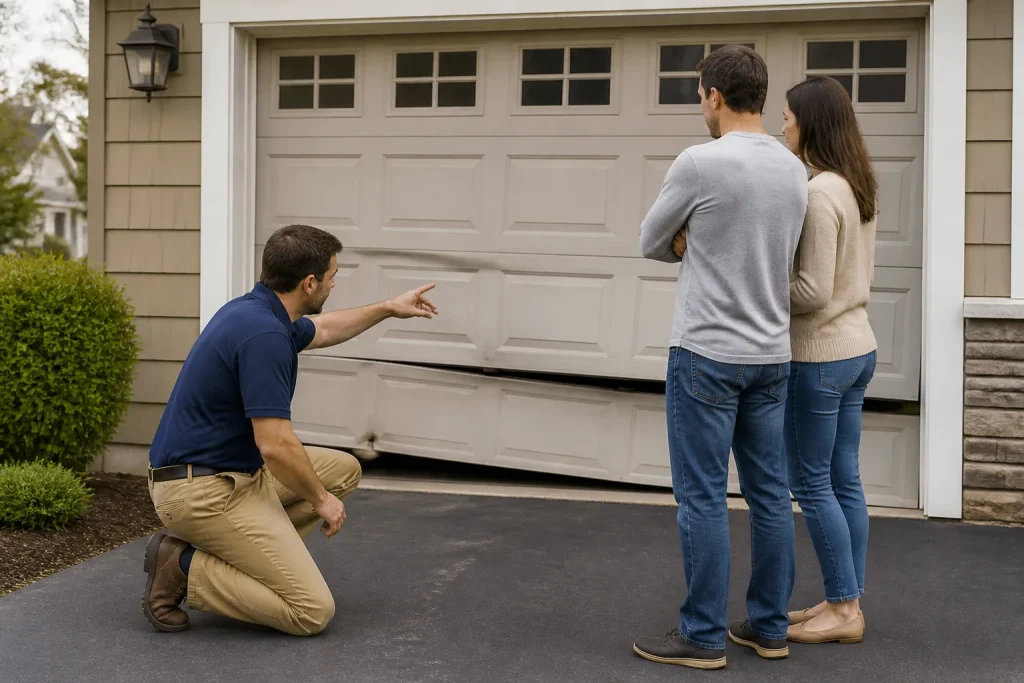
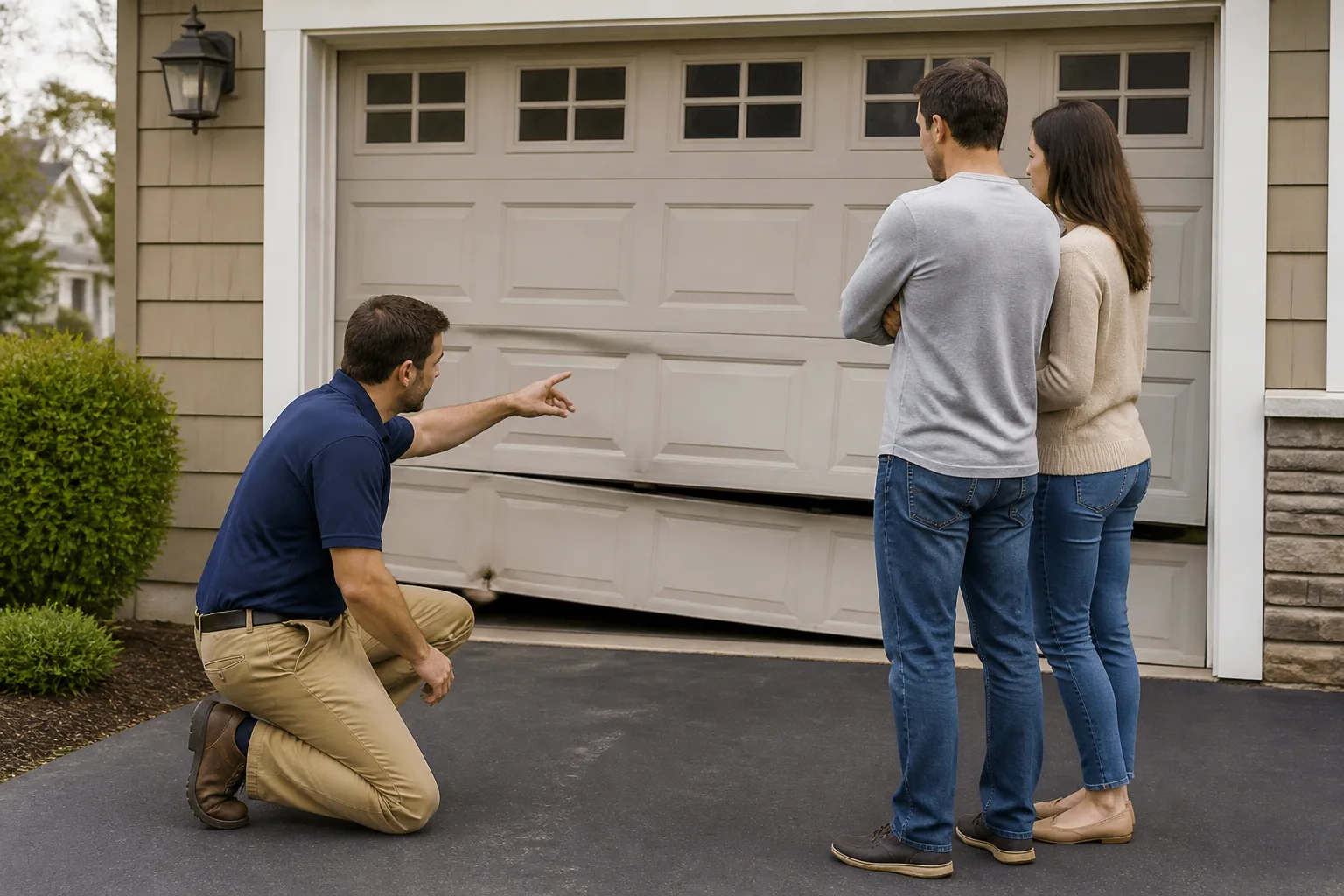
Most garage door decisions get made in a moment of stress, usually with a car trapped inside and a panel hanging crooked. That’s exactly when bad advice lands hardest. Here’s the framework we use: add up what the repair actually costs, check whether the door’s frame and hardware can carry a new door if you go that route, and compare the door’s age to its expected service life. If the repair stays well under replacement cost and the structure is sound, you fix it. If it doesn’t, you replace. That’s the whole calculation, and it doesn’t need a sales pitch attached.
If you’d rather hand the diagnosis to someone who works on your brand every week, call (888) 569-3530. Free estimates, and we’ll tell you which side of the line your door lands on.
What’s the 50% rule, and how does it apply to garage doors?
The 50% rule means you replace the door when repair costs reach about half the price of a new one. On a garage door that math works best over a rolling 12-month window, not one invoice at a time. One spring replacement or one opener repair rarely justifies a new door. But when the repairs stack up inside a single year and the total starts climbing toward half of replacement cost, you’re paying for a door you could own outright.
Here’s how we weigh it in Brick Township:
- One repair, well under half: fix it. A snapped spring, a bent roller, a stripped gear in the opener. These are maintenance, not decline.
- Cumulative repairs crossing half within 12 months: the math shifts toward replacement, especially if the door is already past its expected lifespan.
- Repair estimate approaching half on its own: usually a sign the failure is structural (a cracked section, a bent track, a snapped cable) rather than a worn part.
- Door at or near end of life plus any repair: replace. You’re investing in a door that has little left to give.
Notice what isn’t on that list: how the door looks, how old the opener is, or what a neighbor just bought. Cosmetic wear and opener age are separate questions. We see doors get replaced every week for reasons that had nothing to do with the door. If your setup is structurally sound, same door, fixed right, is almost always the better call. The written estimate sets the final price, and we quote it before any work begins, so you’re never comparing a guess against a proposal.
How do you check whether your door frame can carry a new door?
You check four things: the header above the opening, the jambs on each side, the track brackets bolted to the framing, and the floor where the bottom section meets it. A new door weighs more than most homeowners expect, and the framing has to carry that load and hold the torsion hardware under tension. If any of those four is compromised, a “simple” replacement becomes replacement plus structural repair, and the price you were quoted changes.
Walk through this checklist before you commit to a new door:
- Header: look for sagging, rot, or a header that was never sized for a modern door.
- Jambs: press a screwdriver into the wood at the bottom. Soft wood means rot, and rot means framing work.
- Track brackets: check that the bolts bite into solid framing, not drywall or a patched repair.
- Floor and threshold: a cracked or uneven slab at the opening can throw off the seal and the bottom section.
This is also where a bad decision gets expensive in the other direction. Homeowners sometimes replace a door when the real problem was the opener, the springs, or a track that shifted out of alignment. We work on LiftMaster, Chamberlain, Genie, Clopay, Amarr, Wayne Dalton, Craftsman, and Raynor systems, so we can usually tell from the hardware whether the door itself failed or something bolted to it did. If the door is structurally sound, repairing the opener or the garage door spring repair is often the entire fix.
Is your panel discontinued? Check before you decide a repair isn’t worth it
A discontinued panel changes the math, and it’s the one case where a cosmetic repair turns into a bigger decision. If the damaged section can’t be sourced in your brand and color, a partial fix leaves you with a mismatched door, and that pushes many homeowners toward full replacement sooner than they planned.
Here’s how to check before you decide:
- Find the brand and model. It’s usually on a sticker on the inside of a section or on the opener housing.
- Check current production. Brands like Clopay and Amarr rotate colors and panel profiles out of production over time. A model that’s still made doesn’t guarantee your color still is.
- Ask about lead time. Even a panel that’s technically available may be a special order, which matters if the door is currently stuck or unsafe.
- Weigh a mismatched repair against replacement honestly. If the door is otherwise sound and the mismatch is in a low-visibility spot, a repair still makes sense. If the color is gone and the door is already old, replacement wins.
The trap here is deciding replacement on the assumption that a panel is gone. Check first. If your brand is Genie, Chamberlain, or one of the others we handle, we can tell you quickly whether a section is still obtainable, and that answer often saves a homeowner the cost of a whole door. If repair turns out to be the call, our garage door repair side handles section swaps and track work as a normal job.
When does a new opener solve a door problem?
A new opener solves the problem when the door itself is fine and the failure is in the drive system. That’s more often than most homeowners realize. A door that reverses unexpectedly, stops halfway, or grinds when it lifts may have a healthy panel, track, and spring set, with the fault sitting in the motor, the travel limits, or the safety sensors. Diagnose the door first, then the opener. Not the other way around.
Signs the opener is the real issue:
- The door moves smoothly by hand (with the opener disengaged) and stays balanced partway up. That points to the opener, not the door.
- The motor hums but the door doesn’t move. Often a stripped gear or a failed capacitor, both repairable on LiftMaster and Chamberlain units.
- The door reverses immediately and randomly. Could be a sensor alignment, a limit setting, or a logic board.
- The wall button works but the remote doesn’t, or vice versa. That’s a control or receiver problem, not a door problem.
We’re set up for both LiftMaster and Chamberlain platforms, since those two cover the majority of residential openers in use, and we also handle Genie. If your door is sound and the opener failed, you’re looking at a much smaller repair than a replacement. We’ve seen plenty of homeowners talk themselves into a new door when the real answer was an opener or a board. Before you assume either, let one of our technicians look. Our technicians have up to 12 years of experience with these systems, which matters when the diagnosis is the deciding factor.
The Brick Township factor: how local conditions affect door lifespan
Brick Township sits close enough to the water that humidity and salt in the air shorten the life of a steel door faster than inland homeowners expect. That’s the local variable most national decision guides skip entirely, and it changes when replacement makes sense. It also means a steel door here can show rust and paint failure earlier than its rated lifespan suggests, especially on the bottom section, hinges, and hardware.
How that plays out for the two common construction types:
- Steel doors: humid, salt-bearing air speeds up corrosion on any spot where the finish has failed, particularly along the bottom panel edge and around the hinges. A door that looks fine on the surface may be rusting from underneath.
- Wood composite doors: moisture is the main enemy. Check the bottom section for swelling, softness, and paint that’s failing at the seams. Wood composite is repairable when the damage is caught early.
- Both: hardware and springs are the first to feel it. Lubrication and a yearly look at the bottom section buy you time.
What that means for your decision: if a Brick Township door has cosmetic surface wear and one bad bottom section but otherwise solid framing, repair is usually worth it, provided the parts are available. If the corrosion has worked into the section structure itself, replacement is the honest answer, and a newer finish will hold up longer in the local humidity. The location doesn’t change the framework; it just tips the age-to-lifespan ratio against you a little faster.
When to call a pro
Call a professional before you touch anything on the spring, cable, or torsion assembly. Those parts are under serious stored energy, and a door that comes down or a spring that releases is a genuine injury risk. That’s true whether the repair looks simple or not. This isn’t a DIY component, and we’d rather talk you out of touching it than patch you up afterward. Post a photo from a safe distance and call instead.
Related services in Brick Township: if the failure turns out to be in the motor or the drive, see our garage door opener repair page. If you’re replacing, Garage Door Repair Brick covers the full range from springs and openers to a new door and its installation.
And when it’s urgent, call us. Emergency service is part of what we do, not an add-on, and the price doesn’t go up because you called at a bad moment. The estimate is quoted and agreed before any work starts, urgent or otherwise. We answer 24/7, with fast dispatch from 7am to 7pm Sunday through Friday.
The Bottom Line
Repair beats replacement when the repair cost stays well under half of replacement, the framing and track hardware are sound, the parts are still in production, and the door has service life left. Replacement wins when repairs stack up past 50% within 12 months, the frame or bottom section is compromised, the panel is discontinued, or the door is already past its expected lifespan. And sometimes neither is the right answer, because the whole problem was the opener.
Run the numbers, check the structure, and check part availability before you decide. That’s the sequence, and it works for any door in Brick Township.
If you’re in Brick Township and need help, Garage Door Repair Brick offers free estimates. Call (888) 569-3530 and we’ll diagnose the door honestly and quote the price before we start.
Frequently Asked Questions
Repair it if the fix costs well under half of replacement and the frame, track brackets, and adjacent panels are structurally sound. Replace it if repairs over 12 months approach half of replacement cost, the bottom section or framing is compromised, or the panel is discontinued. Diagnose the door before the opener, since opener failure often looks like a door problem.
It depends on the failure: a spring, an opener part, or a panel swap are very different jobs, so there’s no single number. The written estimate is the price, and we quote it before any work begins. Call (888) 569-3530 for an exact quote, and estimates are free.
No. We inspect, diagnose, and quote the full job before we start, and that written estimate sets the final price whether the repair is routine or urgent. If we find something extra during the work, we stop and tell you before touching it.
Yes, often. If the door balances and moves smoothly by hand but the motor hums, reverses, or won’t respond to controls, the opener is the problem and the door is fine. We work on LiftMaster and Chamberlain systems, which cover most residential openers, so a motor or control fix is usually far cheaper than a door.
Written by the team at Garage Door Repair Brick.
Need Garage Door Help?
Call Garage Door Repair Brick - the local pro we connect you with is licensed and insured, here with fast help in Brick.
(888) 569-3530